

Motor parameter auto-tuning: which method to choose and the step-by-step procedure
Dynamic, static or manual entry? How to choose the right motor auto-tuning method on a Hailing vector drive, the parameters to enter first, and what the drive calculates.
Vector control needs an accurate model of the motor. Before running a motor in sensorless or closed-loop vector mode, let the drive measure the motor's electrical parameters. Skipping this step is one of the most common causes of overcurrent trips (Err02–Err04).
Choosing the tuning method
| Method | When to use it | Result |
|---|---|---|
| No-load dynamic tuning | Asynchronous motor that can be disconnected from the machine | Best |
| Dynamic tuning with load | Motor and machine cannot be separated | Good |
| Static tuning | Motor and load cannot be separated and the motor must not rotate | Good |
| Manual entry | Copy the parameters from a previously tuned motor of the same model into P1-00 to P1-10 | Good |
Procedure for motor 1
- If possible, isolate power and mechanically separate the motor from the load so it can turn freely.
- Power on and set the command source P0-02 to the operating panel.
- Enter the motor nameplate data exactly: P1-00 motor type, P1-01 rated power, P1-02 rated voltage, P1-03 rated current, P1-04 rated frequency, P1-05 rated speed.
- For an asynchronous motor, set P1-37 = 2 (dynamic tuning) and press ENTER. The keypad shows "TUNE".
- Press RUN. The drive accelerates, decelerates and runs the motor forward and in reverse. Tuning takes about two minutes. When the display returns to normal, tuning is complete.
The drive then calculates stator resistance (P1-06), rotor resistance (P1-07), leakage inductance (P1-08), mutual inductance (P1-09) and no-load current (P1-10). If the motor cannot be uncoupled, choose the static tuning option in P1-37 instead.
Two motors on one drive
The drive stores two motor parameter sets: motor 1 in group P1 and motor 2 in group A2 (A2-00 to A2-05 nameplate data, tuning selection A2-37). Select the active set with P0-24 or with digital-input functions 41 and 42, which take priority. In vector mode the drive can control one motor at a time; V/F mode can drive several motors in parallel.
Permanent-magnet motors use a different procedure; see PMSM wiring and parameter setup.
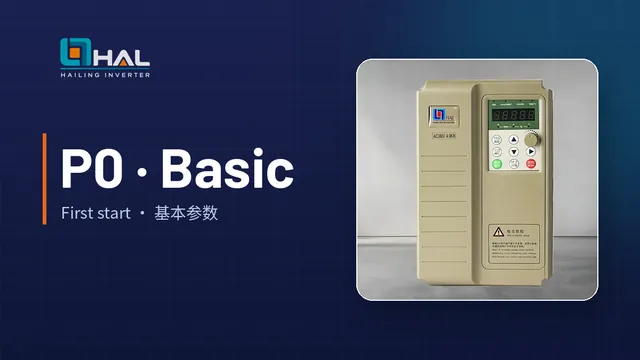
First start-up: the basic VFD parameters to set before you press RUN
Load type, control mode, command source, frequency source, frequency limits, carrier frequency and ramp times: the P0 group parameters that decide how a Hailing vector drive behaves.
Read more
Permanent-magnet synchronous motor (PMSM) setup: wiring and open-loop parameters
How to wire and commission a permanent-magnet synchronous motor on a Hailing drive in open-loop vector mode, including dynamic auto-tuning and the back-EMF check.
Read more
Why VFDs save energy on fans and pumps: the affinity laws explained
Flow follows speed, pressure follows speed squared and power follows speed cubed. How variable-speed control cuts the energy used by fans and pumps compared with dampers and valves.
Read more